
Biological Hallucinations
Dynamic Biological Interpolation
This is an interpolation of many biological images of human, animal and plants cells that I have collected and then ordered, they have been used to generate frame by frame, connections between each different image. As you can observe, it finds the similarity between images and then generates multiple images, smooth enough to look like a video, in between each image to create a living effect, a movement that flows. Each cell - as different as they are - all have a similarity, something that connects them and this is what the AI finds and uses. The images you are observing are entirely unique, they are new, they have been generated by an algorithm that uses real-world living cells to produce them as they move from one state to another.
Each singular image in the video is comprised of five real cellular images of either a human, animal or plant. They where taken at the University of Cape Town using their confocal laser scanning microscope. Each created image was then used to create the video above.
%20t_s_%20showing%20stone%20cells%203.png)
Raw images of cells
This is an image of a real cell, the above image is 'Fruit of Pyrus (pear) t.s. showing stone cells'. Five images such as this one are used to create the merged image. Using a mixture of human, animal and plant cells.
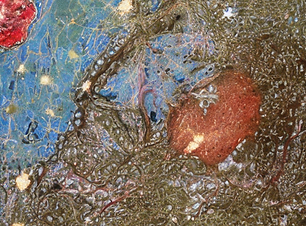
Merged image of cells
This is an example of a merged image, within this image is five raw images of the cells that have been merged to create one image.

Biological Hallucinations
Within this video are all the different merged images of the cells.

The Process
01
Collecting images of cells
Collecting cellular images can be quite complicated as there is a lot that goes into getting an image of a cell. I was lucky enough to have the opportunity to work with a professor at UCT who helped me take my own images on their confocal laser scanning microscope as well as sending me some of the images he had taken to bulk up the data set.
03
Using the merged images
Once there was a new data set of merged images, each merged image made up of five of the original cellular images. I sorted through and ordered them so that they where ready to be put into the video.
02
Creating the merges
This project is based on a generative model and uses stable diffusion. The data that stable diffusion uses is images. It works by iteratively applying a diffusion process to the image. At each iteration, the algorithm computes the diffusion coefficient based on the local image characteristics, such as gradients and edges; multiple biological images were used for this process. This coefficient determines the strength and direction of the diffusion, allowing the algorithm to adaptively adjust the smoothing effect across different regions of the image.
04
Extrapolation
The video is also based on a stable diffusion model, but it extrapolates what it needs from each separate image to create the in between images that you can see in the video, the part that shows that morphing from one merged
